Building traceability across a fragmented garment supply chain
A B2B service that connects garment orders with verified material, supplier, production and compliance evidence across a complex network of manufacturing partners

Challenge
Traceability often broke when materials and information moved between companies. The challenge was to reconnect existing production evidence without introducing excessive work for suppliers.
Approach
The production journey was mapped across four supply-chain tiers through factory visits, stakeholder interviews and continuous co-design with Triwool. The findings informed an order-based B2B platform.
Outcome
The resulting service connected each garment order with its production stages, responsible suppliers and supporting evidence. It helped identify missing records, monitor compliance and prepare verified information for brand clients.
A garment may carry one label, but its production involves material suppliers, mills, manufacturers, laboratories, auditors and subcontractors.
Evidence about this journey already existed in purchase orders, certificates, inspections, test reports and production records.
The problem was that it remained distributed across companies, formats and systems.
As part of the SUGAR Network programme, I joined a five-person international team working with Portuguese garment company Triwool.
Our assignment was to explore how fragmented production evidence could become a trustworthy garment history. My focus was making the system visible and translating it into a practical digital service.
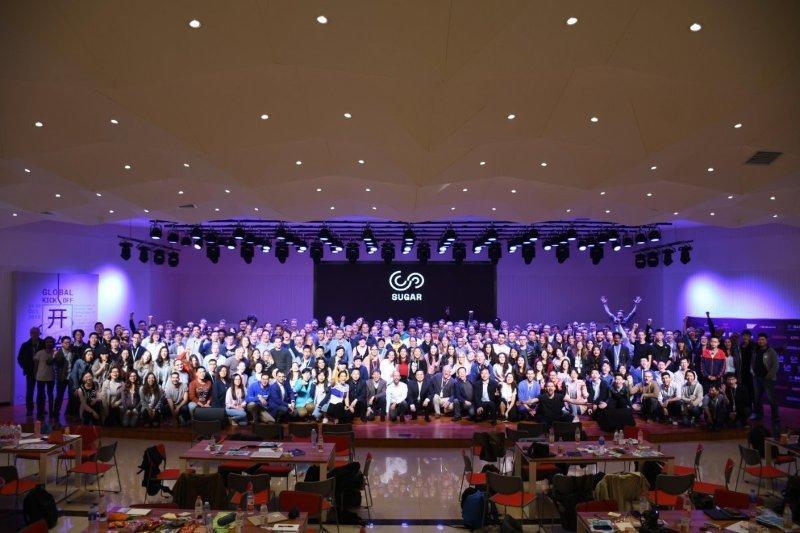
The project started with a global kickoff in China, continued through research and prototyping in Porto and Milan, and concluded with a final presentation in San Francisco.
Timeline
Kickoff
Framing the brief with partners in China.
Research
Interviews, experiments and industry benchmarking.
Mapping
Factory visits across four supply-chain tiers.
Prototyping
Testing consumer, material and digital directions.
Convergence
Co-designing the B2B service with Triwool.
Delivery
Refining and presenting the concept in San Francisco.
Evidence existed, but its relationship with the garment was difficult to preserve
Triwool coordinated design and production while specialised partners handled sourcing, knitting, finishing and manufacturing.
A certificate could show that a supplier met a standard, but not necessarily that its certified material was used in a particular garment. An audit described a facility, while a test covered a specific sample or production batch.
As materials were transformed, divided and combined, the relationship between the garment and its evidence became increasingly difficult to follow.

The design question was not simply how to collect more data, but how to connect each record to the material, process and order it actually supported.
Making the production system visible
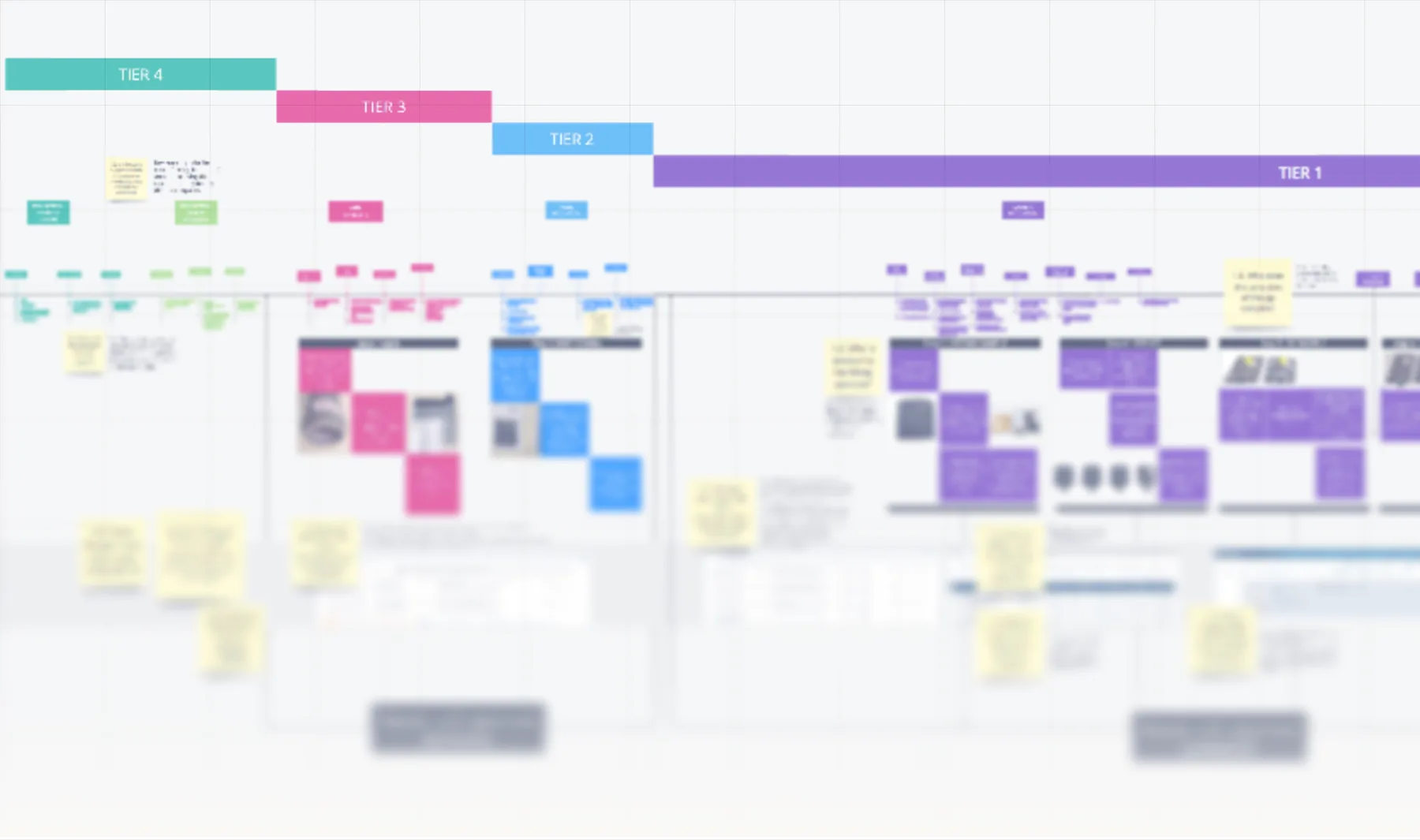
My main contribution during discovery was translating research into a shared production journey.
For each stage, I mapped material transformations, responsible companies, supporting records and partner handovers. This revealed where evidence was lost and helped the team discuss gaps directly with Triwool and its partners.
Learning through prototypes
The SUGAR framework helped us test customer behaviour, material verification and production management in successive rounds.
I contributed to ideation, prototyping and synthesis, carrying each round’s findings into the next.
01 · Could information change behaviour?
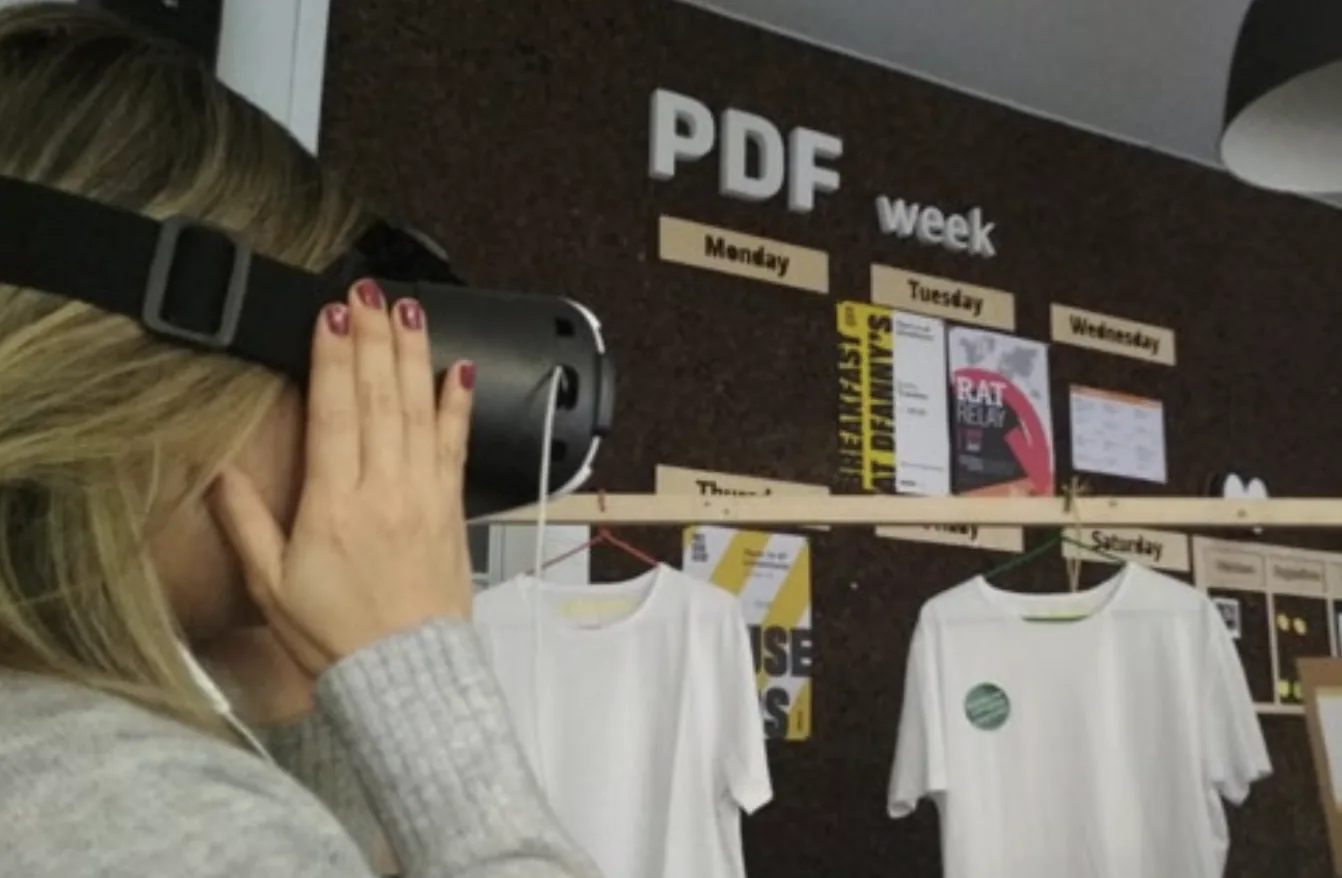
We tested a garment label, VR experience and factory simulation. Awareness increased, but price remained the main purchasing driver.
Learning:
Communication could support traceability, but not create evidence.
02 · Could the material verify itself?
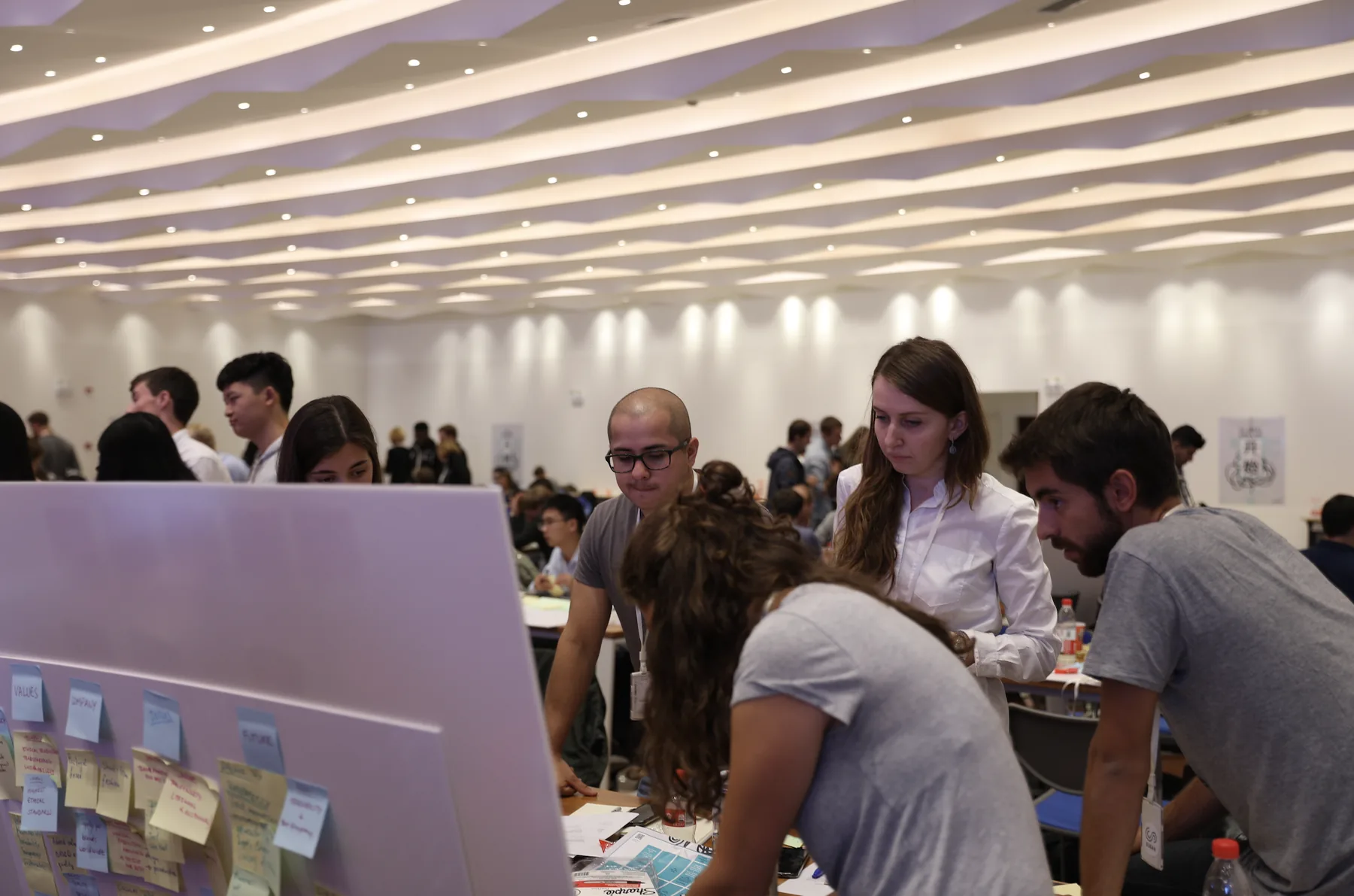
We explored material fingerprints, coded yarn and a simulated scent scanner. Each required specialist processes and could verify only part of the journey.
Learning:
Authentication alone was not a traceability system.
03 · Could companies share a product history?
I helped prototype garment orders across suppliers, certificates and production stages. This exposed growing complexity in data, permissions and missing records.
Learning:
The service needed to follow orders, not become a supplier marketplace.
04 · Could traceability fit existing work?
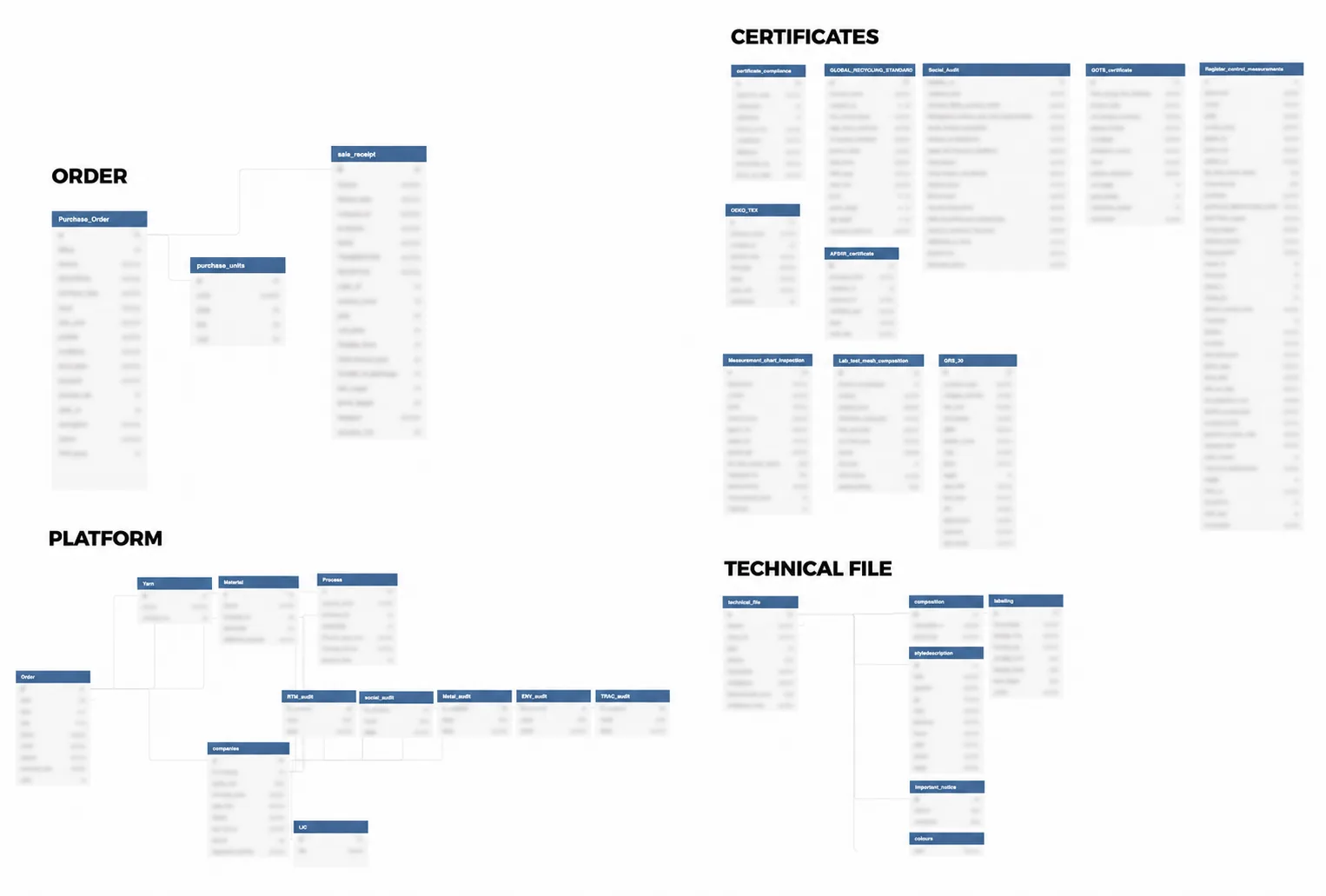
Using documentation from several real orders, I structured the platform’s information architecture and key flows.
Learning:
Traceability worked best when built into existing production activities.
The system in numbers
PRODUCTION AND COMPLIANCE FIELDS STRUCTURED
SUPPLY-CHAIN TIERS MAPPED
PROTOTYPE ROUNDS COMPLETED
GARMENT ORDER TRACED END TO END
Solution
Research showed that traceability needed to become part of production management, not a separate sustainability tool.
The platform was therefore organised around garment orders already used to coordinate production. From each order, teams could follow its progress, identify responsible suppliers and review the evidence supporting every stage.
Operations
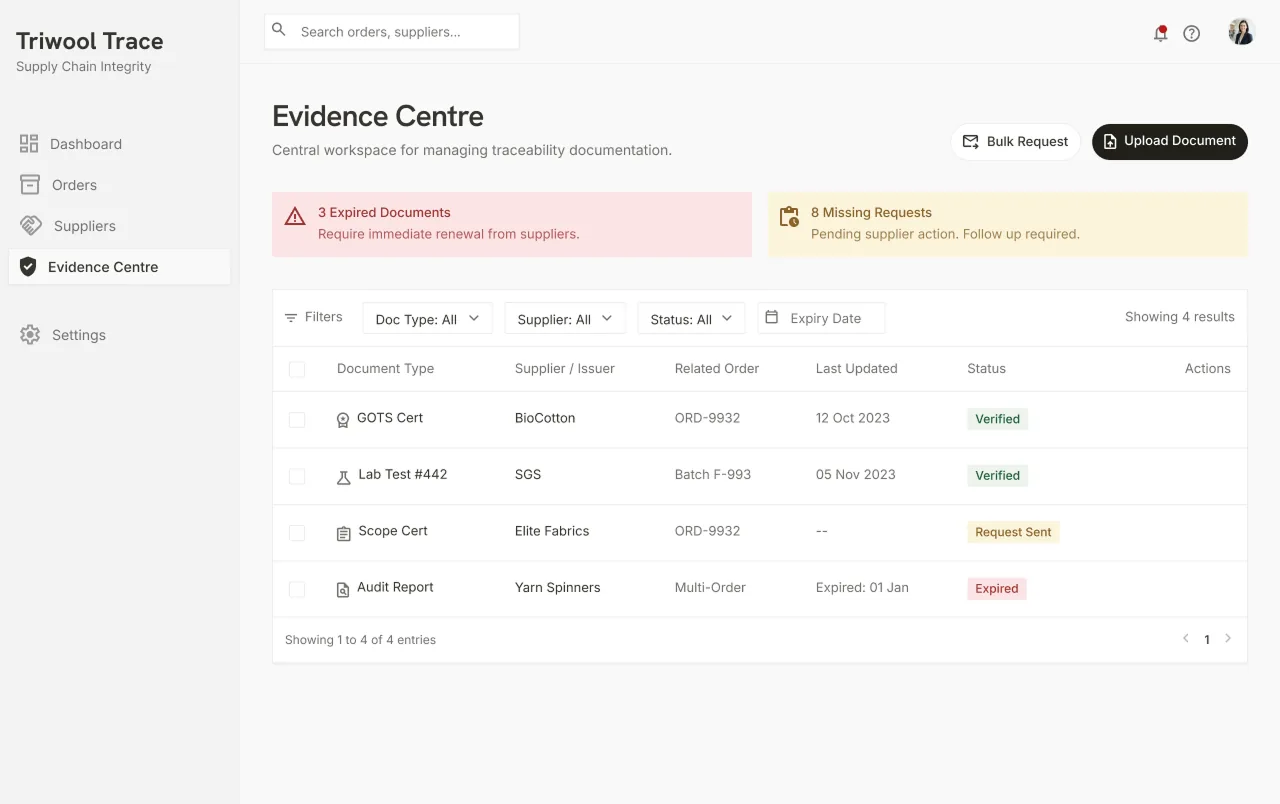
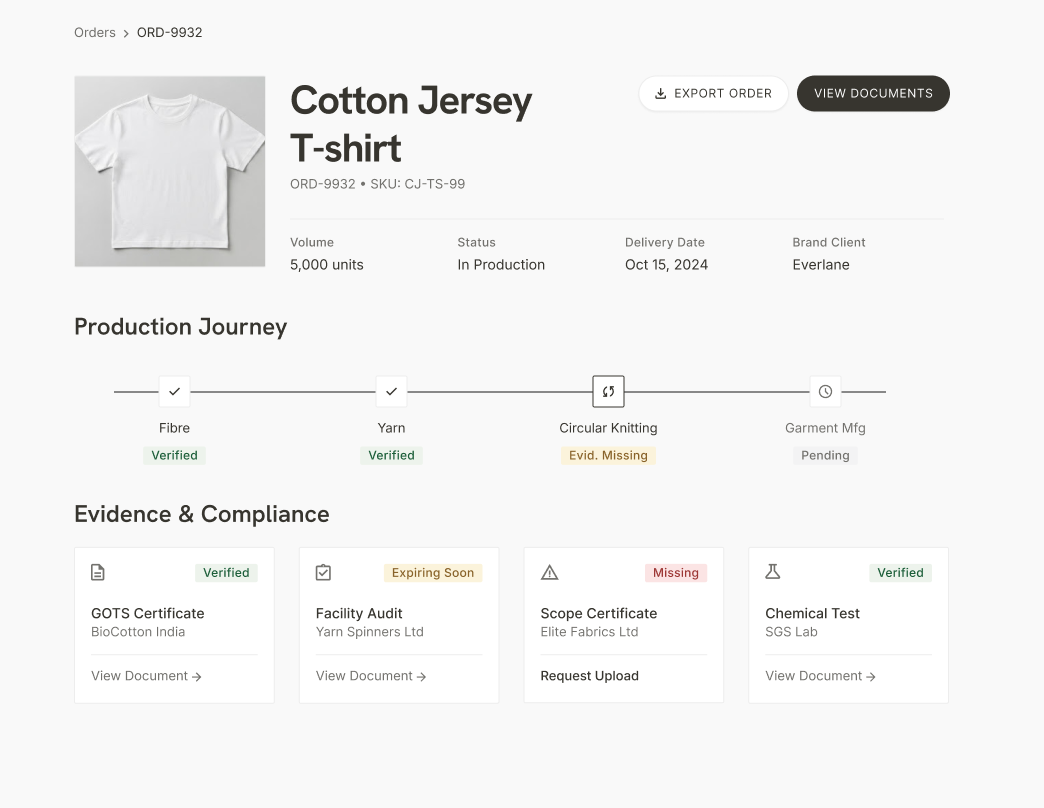
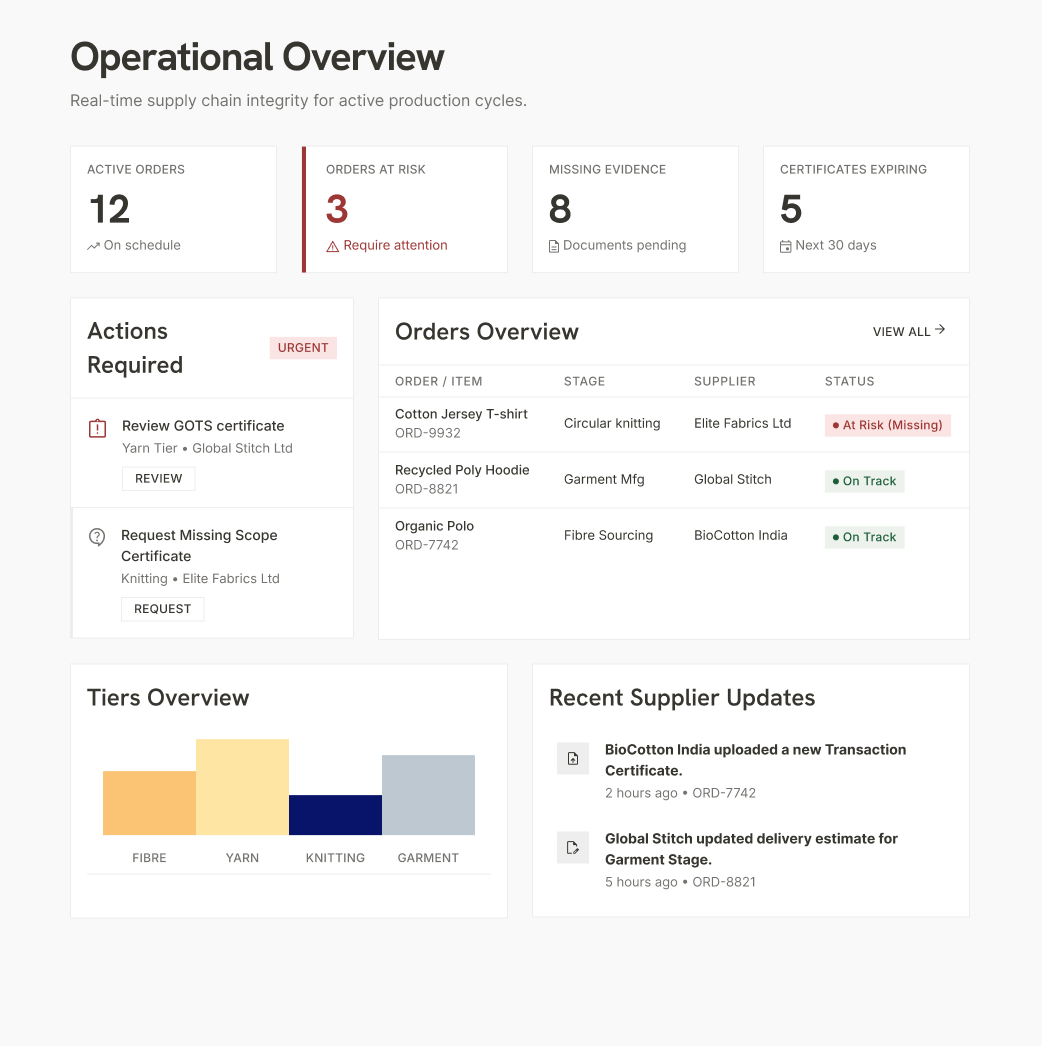
The dashboard gives production teams an overview of active orders, risks and missing evidence. Selecting an order reveals its production journey, responsible partners and the status of supporting documents.
Verification
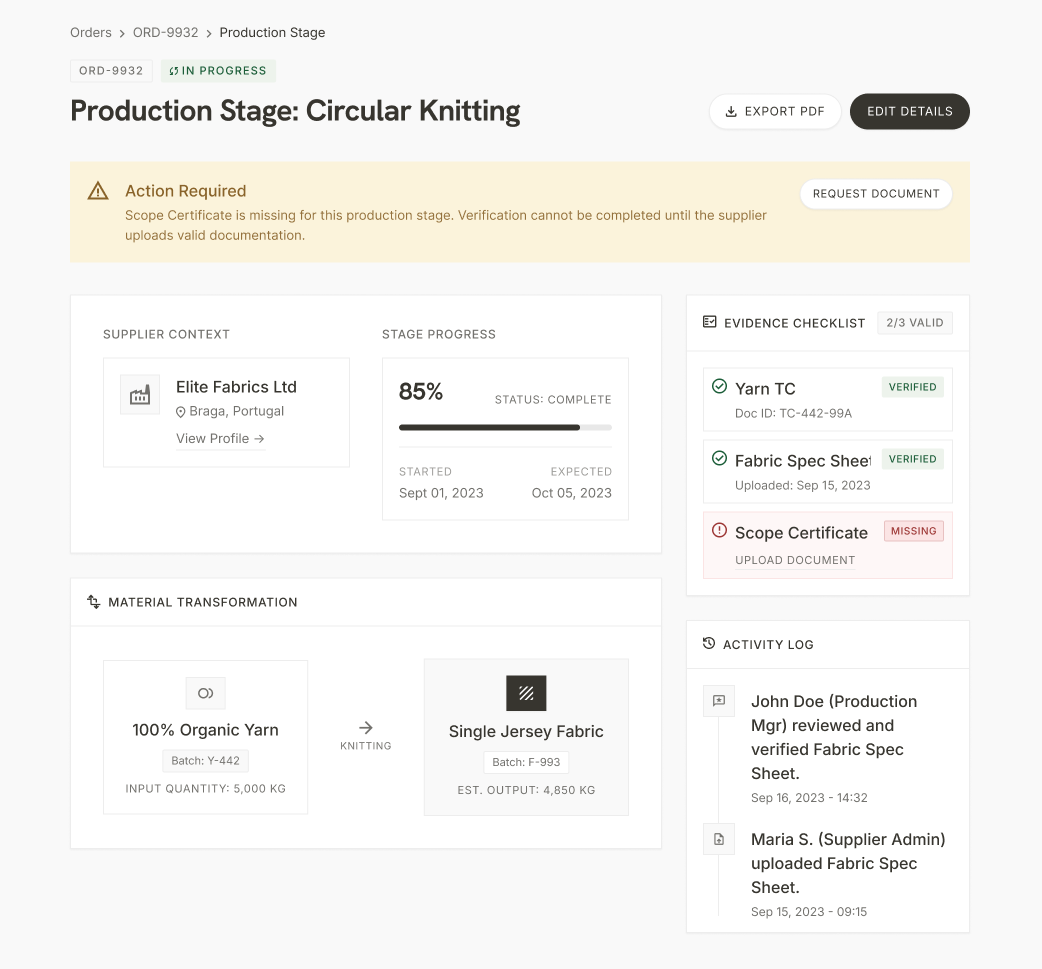
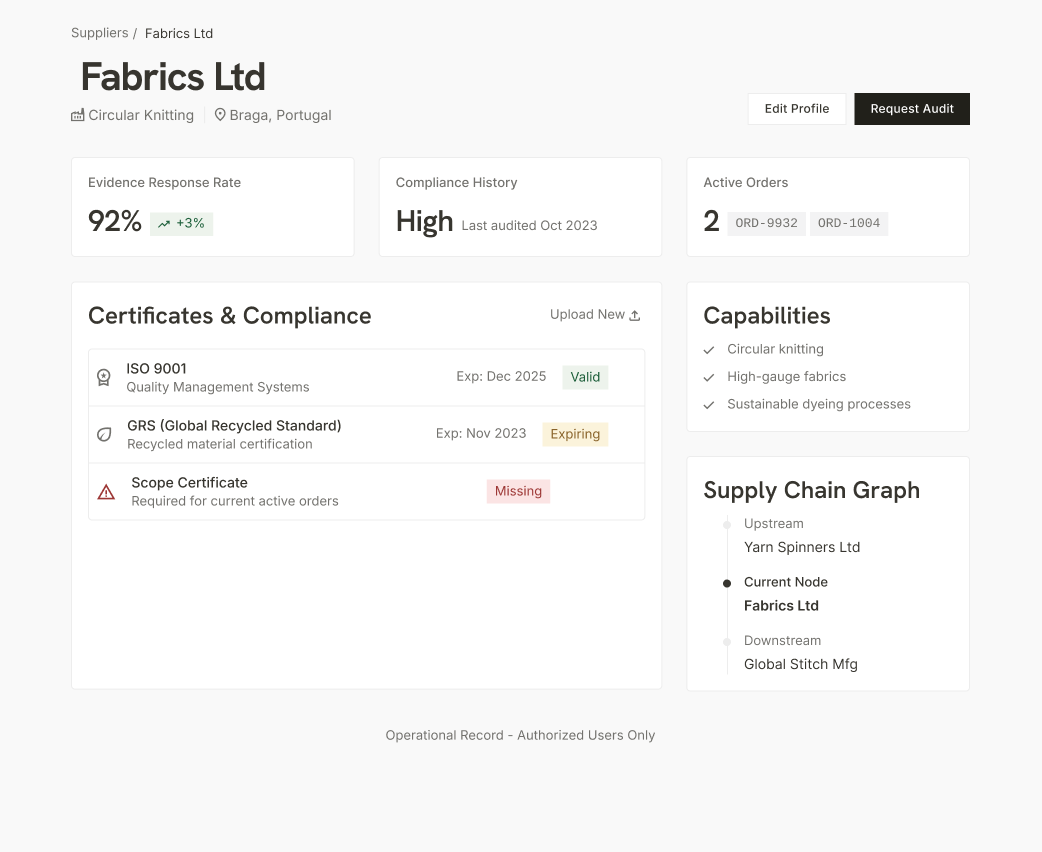
At production-stage level, the service connects a material transformation with its responsible supplier, progress and required evidence. The supplier profile brings together capabilities, active orders and compliance history.
Missing or expiring evidence becomes an actionable task connected to the company responsible for providing it.
Validation
Feedback helped refine how users would navigate and act through the platform
Reviews with Triwool and production specialists shifted the interface from displaying traceability data to supporting everyday production decisions.
Prioritise exceptions
The dashboard needed to surface missing certificates, approaching deadlines and incomplete orders instead of presenting every available data point with equal importance.
Make responsibility actionable
Role-based access allowed suppliers to contribute relevant records without seeing sensitive information. Production managers could request documents, review submissions and confirm completion directly in the platform.
Organise by order
Users needed to search by order or supplier, then open one order to see its production stages, participating companies and evidence completeness in context.
Service model
A subscription platform connecting brands with their production partners
The business model separated the organisation paying for traceability from the companies contributing production evidence.

From an open brief to a tangible B2B service
After nine months, the project concluded with a final presentation at the SUGAR Network event in San Francisco. The team demonstrated a functional B2B platform concept, service model and development roadmap to an international audience of academic and corporate partners.
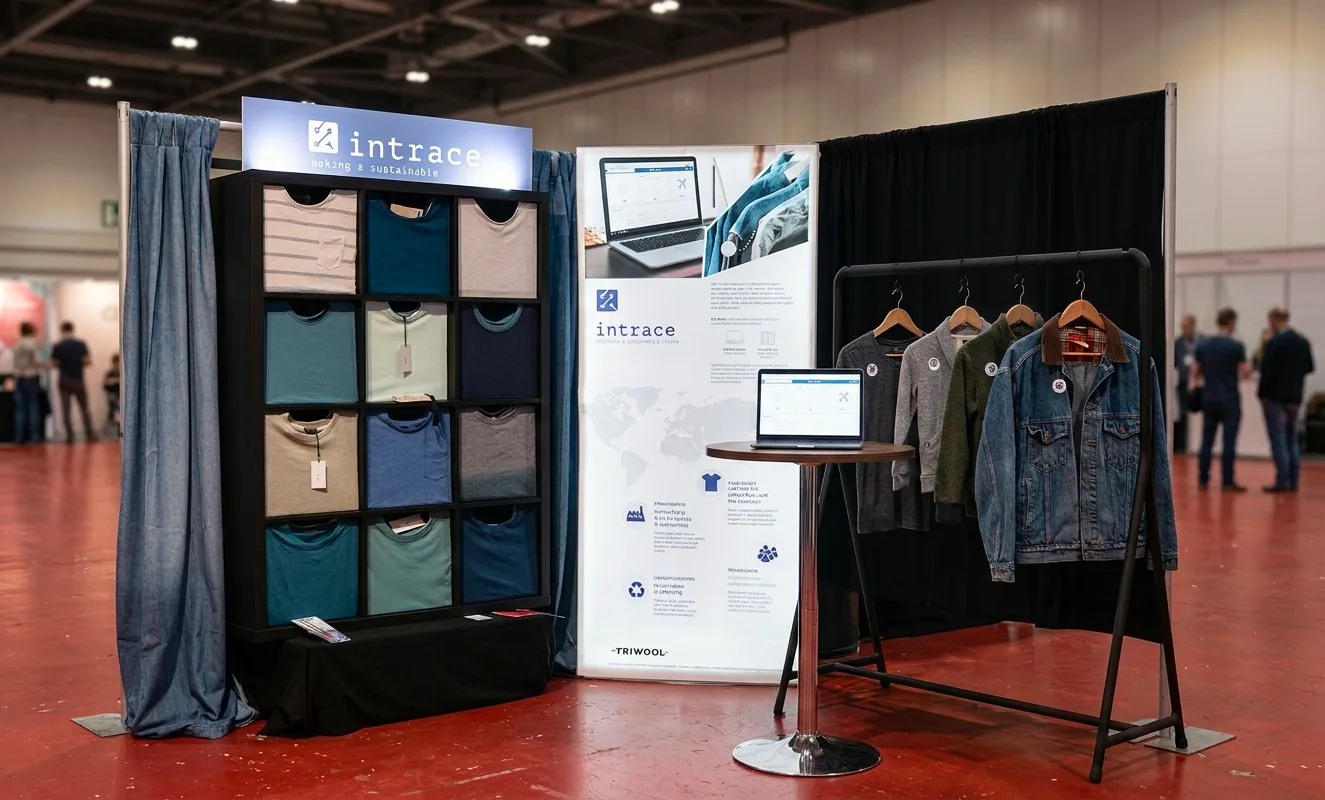
The project transformed a broad traceability brief into a concrete service organised around garment orders. It gave Triwool a clearer framework for connecting production stages, supplier responsibilities and compliance evidence, while identifying what would need to be tested, integrated and developed before implementation.
Learnings
Adoption depends on daily operations
Even a strong traceability concept will fail if it creates additional administrative work. The most viable solution reused information already produced during manufacturing and made missing evidence part of existing order-management workflows.
Prototype the uncertainty first
Different prototype rounds helped test customer behaviour, physical authentication and platform workflows separately. This prevented the team from investing too early in one technically complex direction.
Transparency requires shared incentives
Making information visible was not only a technical or design challenge. Each company had different responsibilities, capabilities and reasons for sharing data. A viable service therefore needed to create value for every participant, not only satisfy the information needs of the organisation requesting traceability.
Looking for more detail on this project, or have a similar challenge in mind?